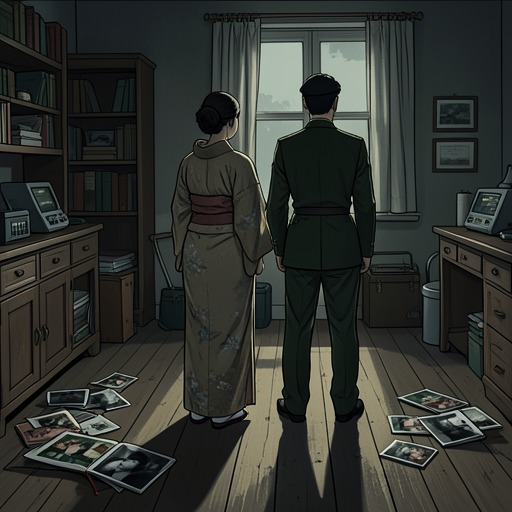
Lucy's discovery of Sachi in Teiji's photographs
The Earthquake BirdLucy’s discovery of Sachi in Teiji’s photographs turns an act of curiosity into an intimate confrontation with a past Teiji had not shared. The pictures offer Lucy a partial history of another woman, while exposing the limits of what images can explain: they show Sachi’s changing appearance and circumstances, but not the full story of her relationship with Teiji or what became of her.
The Search in Teiji’s Apartment
Lucy has been drawn to Teiji’s camera from their first encounter in Tokyo. Outside the Keio Plaza Hotel, she watches him photograph a puddle, then steps into its reflection; he captures her feet and face in one of the first pictures he takes of her. She understands the act as an invitation into his image, and imagines that being photographed has brought her inside him. Later, that sense of photographic intimacy becomes the prelude to a more unsettling discovery: Teiji has a private collection she has never been allowed to see.
After Teiji leaves, Lucy decides not to prolong her anxious speculation. She retrieves the spare key hidden in a crack beside his front door and lets herself into his apartment. Though she knows the room’s familiar nooks, specks, and stains, she also recognizes the boxes of photographs as forbidden territory. The first box contains pictures of Teiji’s childhood, which she puts aside. In the other, she bypasses photographs from his arrival in Tokyo and images taken of her, searching instead for the years in between—the time before he met her.
Sachi’s Image Sequence
Among pictures of water, pavement, train stations, and tunnels, Lucy finds a photograph of a woman looking through a bus window. The woman has a soft, round face, deeply set eyes, and a bob brushing her chin, but her tired, angry expression makes Lucy wonder whether Teiji had loved her before he found Lucy. Rather than stopping at this first image, Lucy follows the photographs backward to find the beginning of the sequence.
The earliest picture shows Sachi alone on a small, dark stage, dressed in a soldier’s uniform with a gun over her shoulder. Her mouth is open in a silent shout. Lucy cannot tell whether Teiji attended the play because he already knew Sachi or encountered her there by chance. The photographs before the stage scene do not resolve the question: they show a man in a noodle shop, smiling stiffly at the camera through damp, red eyes.
Following Sachi forward, Lucy sees her in other theater photographs and in coffee shops, parks, beside a river, and at parties. The sequence shifts in emphasis. Sachi appears less often as an actress and more often sitting at parties, on worn tatami, or on a bed. Across the images her face becomes fuller and paler; she seems increasingly sad, and her tight-fitting clothes are crumpled and stained. The last picture Lucy sees shows Sachi lying face-down on the pavement, her head turned to one side and the corners of her mouth raised in an expression Lucy cannot distinguish as a grimace or a smile. The photographs preserve a sequence of visible changes, but leave Lucy unable to know what happened to Sachi or what the final image means.
The Interruption and Teiji’s Account
Teiji enters without Lucy hearing him, or while she is too absorbed in the pictures to notice. He tells her that the photographs are private. Lucy is caught looking through the boxes and feels ashamed of having been discovered, though she admits to herself that she is sorry chiefly because she was caught, not because she looked. The breach makes the intimacy of their relationship newly uncomfortable: she knows the room, but has crossed a boundary Teiji did not open to her.
Lucy asks who the woman was. Teiji names her as Sachi and says that she is gone. He explains that their relationship ended, that Sachi left, and that he did not try to find her. He tells Lucy that he found her and no longer thinks of Sachi, describing loss as something followed by looking for the next thing. His answer gives Lucy a basic outline of their past, but does not fill the gaps the photographs have made vivid. It neither explains the deterioration she thinks she sees nor confirms what happened in the final picture.
Jealousy, Guilt, and the Meaning of the Photographs
Lucy cannot accept Teiji’s assurance as a clean resolution. She finds it difficult to believe that he no longer thinks about Sachi, because she is already certain that she herself will not stop thinking about her. When Teiji and Lucy make love, Lucy cannot enjoy it: guilt over entering his apartment and looking through his photographs mingles with the image of Sachi’s unhappy face. Teiji’s lack of visible anger does not quiet her unease; instead, the photographs remain present in the relationship as a third, unseen presence.
The next morning’s bright weather means a planned hike can go ahead. Lucy welcomes the chance to see other people and get away from Teiji and Sachi, while also looking forward to seeing Natsuko. Her relief marks a practical consequence of the discovery: even after Teiji has explained who Sachi was, Lucy needs distance from both him and the images she has seen.
The episode also establishes a tension that recurs around Teiji’s photography. A photograph can make someone visible without making that person knowable, and the photographer controls what is kept while the viewer supplies meanings the image cannot settle. Lucy’s later reflections explicitly return to the question of what became of Sachi. In a separate episode, Teiji’s photographs of Lily help establish that Lily was alive after the time Lucy’s account had made consequential; those images can support a limited factual conclusion without proving who killed her. Read alongside Sachi’s sequence, that later use sharpens the distinction between what a photograph records and what its observer suspects. Lucy’s discovery therefore reveals both a hidden relationship and the unstable gap between looking closely and knowing the truth.